DISCUSS A PROJECT →
EN
Home Design Services Projects About Contact
Français English Español Italiano 中文 日本語
← All projects
Business tools 2026

Building the back officeof a Paris creative studio

Bringing order to the management reference base, then four tools plugged into it, hosted and monitored.
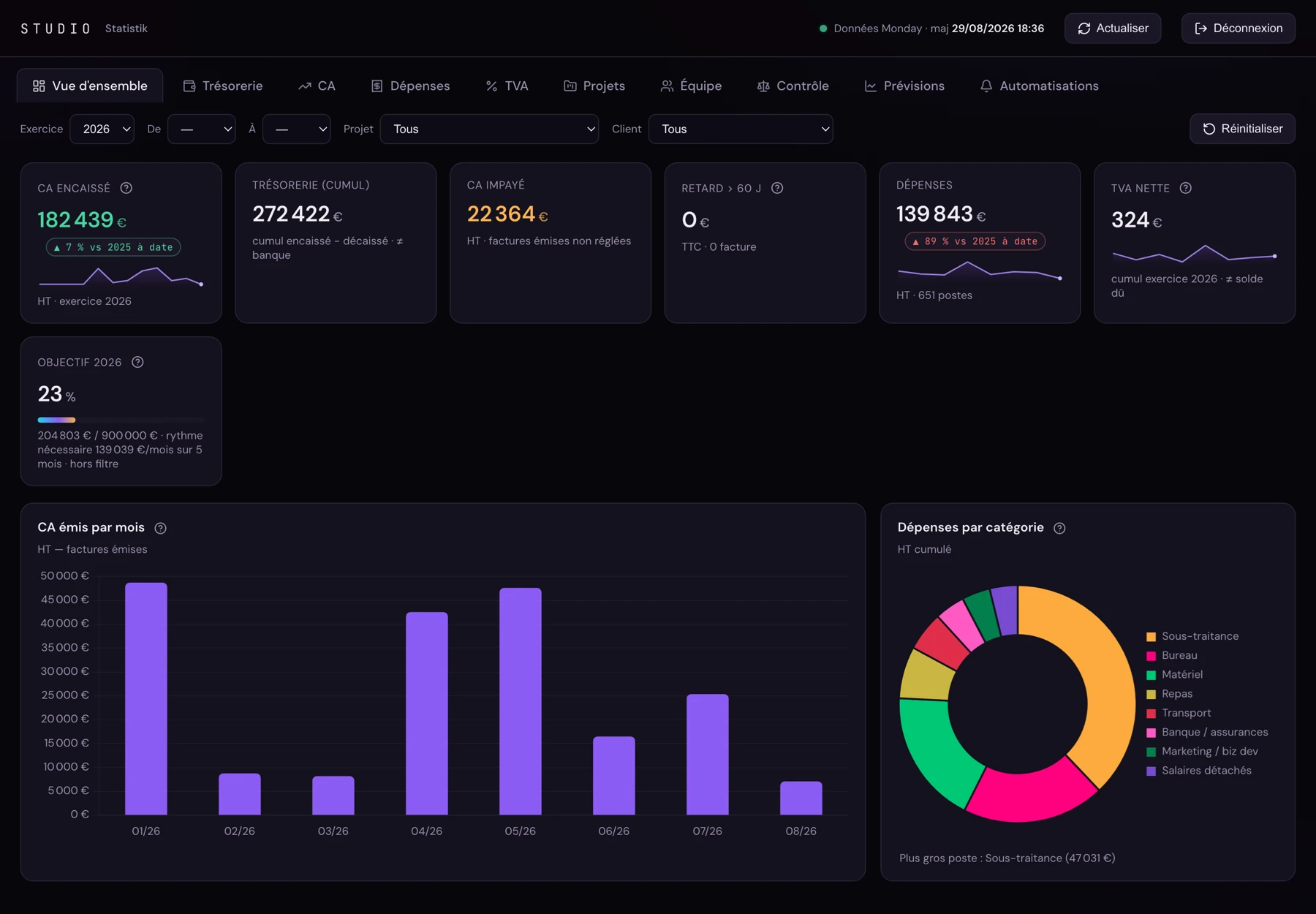
Executive dashboard: revenue, cash, expenses, VAT, margin per project
Executive dashboard · real interface, anonymized data
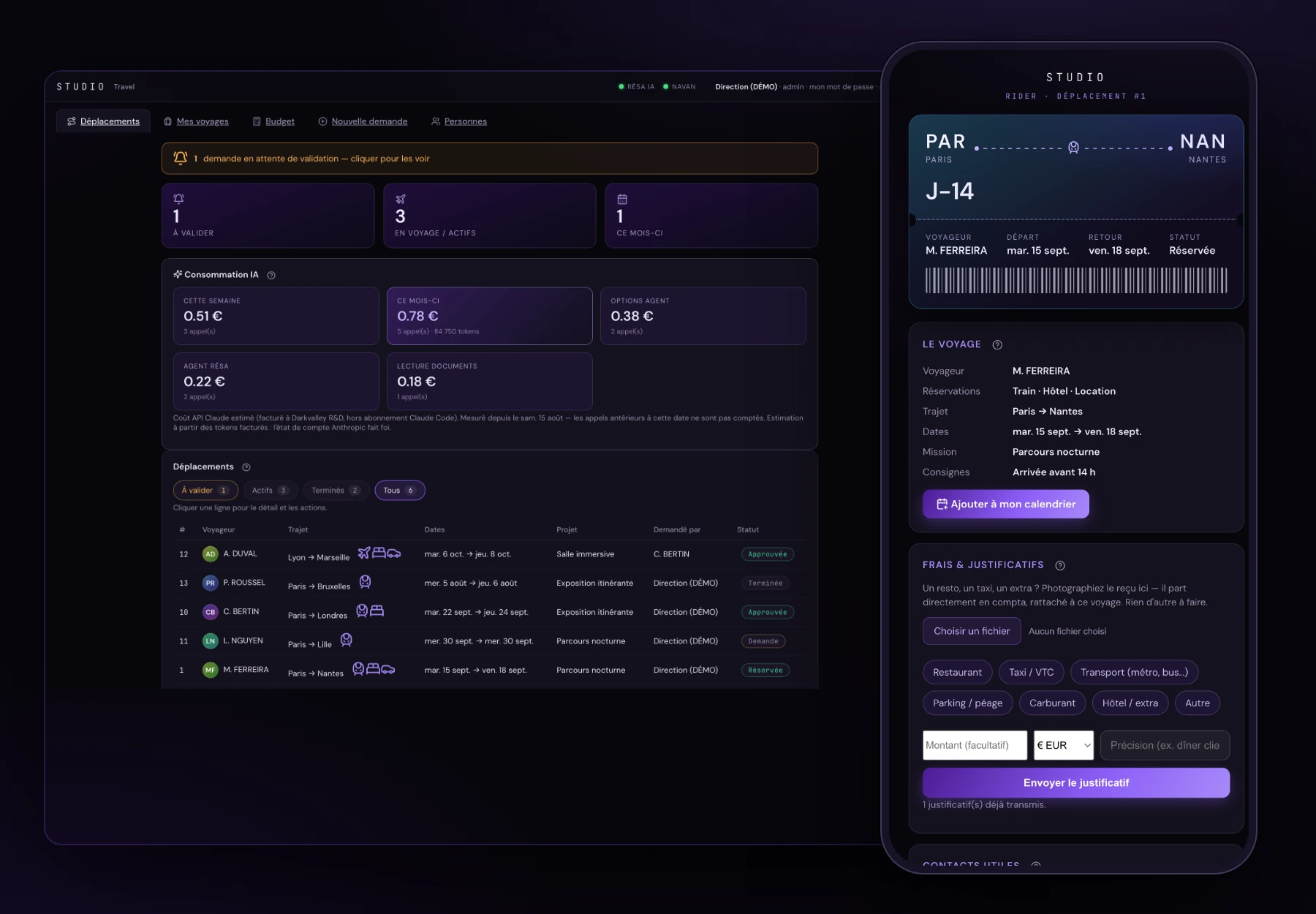
Travel desk: the manager's board and the traveler's rider on their phone
Travel desk and traveler's rider · real interfaces, anonymized data
The context

Four or five pieces of software that did not talk to each other: project management, accounting, shared files, mailboxes. Everything moved from one to the next by hand.

The cost was not data entry, it was the lag: the month's figures arrived the following month, and a project's margin was discovered at the end.

Four tools, rolled out over the course of 2026.

Centralize before automating

We did not add one more piece of software: we designated a single source of truth, the project-management tool. Most of the work is not spectacular, it is groundwork: nomenclature, categories, billable or not, deductible VAT down to the line item. Without that reference base, you automate disorder.

It then lives on its own: programs cross-check the data, flag contradictions, file the documents and add the missing context.

The existing ecosystem
Source of truth
Monday.com
Accounting
Pennylane
Documents
Google Workspace
Travel
Online travel agency
Data structuring · Automation · Dashboards Technical design studio · live shows and permanent installations
Bringing order to the management reference base, then four tools plugged into it, hosted and monitored.

Automate the tedious. Give people back the big picture, the choice and the informed decision. The studio's management tool has become the single reference base for its activity: information is entered once, and management sees its figures the same day.

What Darkvalley brought
  • The reference base. Nomenclature, categories, statuses, time spent, VAT per line item: every piece of information has a place, and only one.
  • Receipts. An uploaded invoice is read, checked, forwarded to accounting and booked to the right project. A weekly report isolates what needs a decision.
  • Contracts and travel. One row in a board produces a contract ready to sign; a travel request is approved in one click, and the documents come back to file themselves on the project.
  • The dashboard. Revenue, cash, VAT, margin per project, time spent: read from the reference base, never recalculated on the side.
  • The check that comes back through. Every quarter, an automated check goes back over the lines, recalculates and reports the discrepancies. The decision stays with the studio; the verification is systematic.
Why us

Darkvalley designs staged experiences: we know these trades from the inside, and the reference base looks like the trade rather than like a piece of software. Our work does not stop at show control: equipping the back office of a creative company means giving it back the hours taken from design.

Project carried out under a non-disclosure agreement. The screenshots show the real interfaces, fed with an anonymized dataset.